Brisbane takeaway
This article is written for Brisbane and South East Queensland conditions. If you want qualified help applying it at your property, the most relevant next step is lawn mowing and lawn care.
Founder & Lead Horticulturalist
About the author
Stan O'Donnell is the founder of The Garden Barber and a lead horticulturalist with more than 20 years of Brisbane garden experience.
Read Stan O'Donnell's backgroundWhat makes summer lawn care different in South East Queensland?
South East Queensland lawns deal with a fairly specific mix of pressure. Heat builds quickly, humidity stays high, storms can dump a lot of water in a short window, and then a run of dry days can stress the turf all over again. That is why a lawn can look fine one week, then patchy, soft or burnt the next.
For most Brisbane homes, the answer is not more mowing and it is not more fertiliser. The answer is getting the basics right in the right order: mowing height, watering depth, soil condition, drainage and timing. If those are wrong, the lawn keeps going backwards no matter how much effort you throw at it.
How often should you water a Brisbane lawn in summer?
A Brisbane lawn usually does better with deep, less frequent watering than light daily watering. The goal is to wet the root zone properly so the grass learns to chase moisture deeper into the soil.
As a practical guide, most established lawns respond well to one or two deep waterings a week, adjusted for rainfall, soil type and lawn variety. Sandy soils dry faster, shaded areas hold moisture longer, and compacted sections can repel water unless they are treated properly.
What does deep watering actually mean?
Deep watering means enough water to soak past the surface and into the active root zone. In practical terms, that usually means checking whether moisture has made it down rather than assuming a green surface equals a hydrated lawn.
A quick way to test this is to water, wait a little, then check the soil below the surface with a screwdriver, trowel or soil probe. If the top is wet but the soil beneath is still dry, the lawn has not had a proper drink.
When is the best time to water?
The best time is early in the morning, ideally before the day heats up. That gives the lawn time to absorb water before evaporation ramps up and reduces the risk of fungal issues that can come from wet turf sitting overnight.
Late afternoon watering is usually second best. Night watering is the least attractive option in a humid Brisbane summer because it leaves the lawn damp for too long.
How high should you mow in summer?
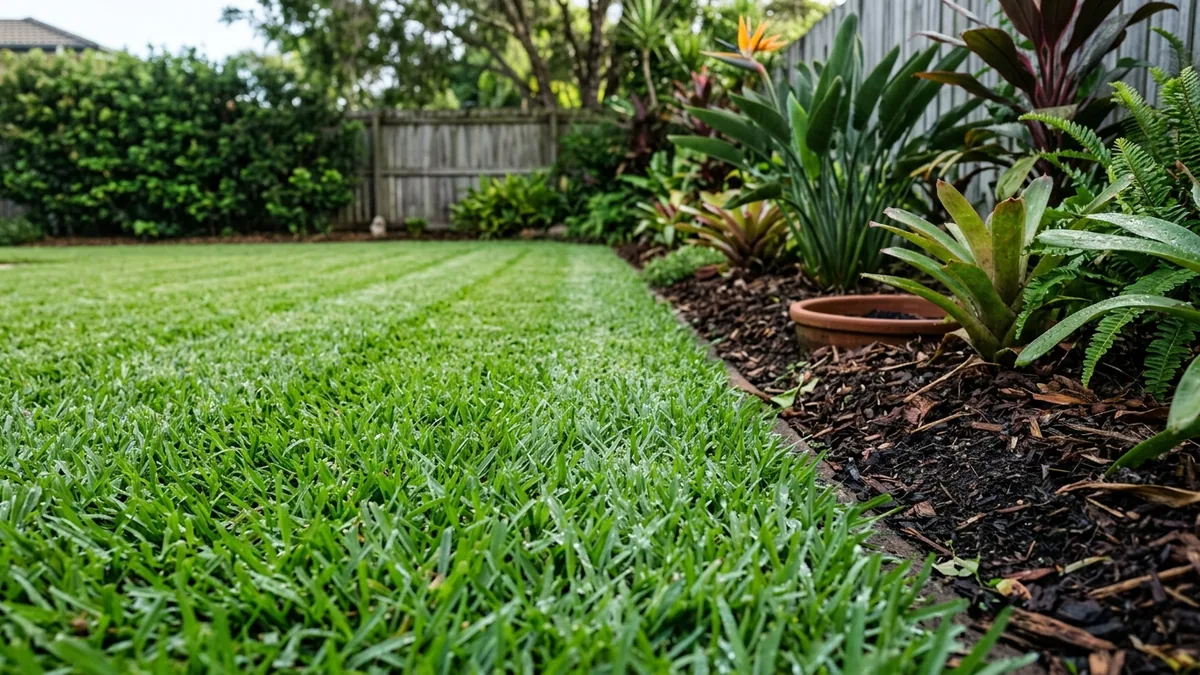
Most Brisbane lawns should be kept slightly higher through summer than people expect. A taller leaf blade helps shade the soil, reduce evaporation and protect the crown of the grass from heat stress.
If you scalp the lawn because it looks tidy on day one, you often buy yourself a week or two of recovery problems. The lawn loses resilience, weeds find room to move in and bare or burnt patches show up faster.
What is the biggest mowing mistake people make?
The most common mistake is taking off too much at once. If the lawn has got away from you, do not try to smash it back in a single cut.
Bring it down gradually. A good working rule is to avoid removing more than about a third of the blade in one mow. That keeps stress down and leaves the lawn with enough leaf area to keep recovering.
Does blade sharpness really matter?
Yes, more than most people realise. Sharp blades cut cleanly. Blunt blades tear the grass, which leaves the lawn looking pale, ragged and stressed.
A clean cut also helps presentation. If a lawn looks a bit grey or furry a day after mowing, the blade is often part of the problem.
What should you do when summer rain is inconsistent?
Inconsistent rain is normal in Brisbane. One week the lawn gets smashed by storms, the next week it is hot, windy and dry again.
That is why lawn care needs to be based on observation, not just a fixed routine. Watch the colour, the recovery after foot traffic, the moisture level under the surface and how quickly the lawn dries after rain. Those signs tell you more than the calendar does.
How do you know if a lawn is overwatered?
An overwatered lawn often feels soft and spongy, stays wet for too long and may start showing signs of fungal activity or patchy thinning. In heavy soils, overwatering also reduces oxygen around the roots, which slows recovery and weakens the turf.
If certain areas stay wet long after the rest of the lawn has dried, you may have a drainage or compaction issue rather than a simple watering issue.
What fertiliser approach works best in a Brisbane summer?
Summer is usually not the time to throw aggressive fertiliser at a struggling lawn. If the grass is already heat-stressed, pushing too much soft top growth can make the problem worse.
A better approach is to support root health, improve soil condition and use measured products that suit the season. Slow-release feeding and soil improvement generally produce steadier, more resilient turf than quick-hit synthetic growth spikes.
Should you fertilise a stressed lawn?
Usually with caution. If a lawn is heat-stressed, pest-damaged or dealing with poor drainage, the priority is to solve the underlying stress first.
Feeding a lawn that cannot properly use the nutrients often creates more growth than the roots can support. That can leave you with more mowing and less real improvement.
Which pests and diseases are common in summer?
The main issues we keep an eye on through Brisbane summers are lawn grubs, caterpillar activity, fungal problems after humidity, and patchy decline caused by compaction or poor drainage.
Birds pecking a lawn can be a useful clue. So can sudden thinning, circular discolouration or a section that never seems to recover even when the rest of the lawn improves.
What should you do if patches keep appearing?
Do not guess and keep throwing products at it. Repeated patching usually means there is a reason underneath the symptom.
It could be pest pressure, hydrophobic soil, poor irrigation coverage, compaction, shade, drainage or even mower damage from repeated scalping. The right fix depends on the actual cause.
Is organic lawn care realistic in Brisbane?
Yes, provided people understand what organic-first care actually means. It is not neglect, and it is not pretending every lawn problem disappears with compost.
Organic-first lawn care means focusing on soil health, root strength, measured nutrition and practices that reduce unnecessary chemical dependence. In Brisbane conditions, that can work very well, especially when the lawn is managed consistently rather than treated as an emergency every few months.
What is the best way to improve a tired lawn without replacing it?
Start by figuring out why it is tired. A lot of Brisbane lawns are not beyond saving, they are just being managed in a way that keeps repeating the same stress.
The usual sequence is to review mowing height, irrigation coverage, compaction, drainage, soil condition and any pest or disease pressure. Once those are addressed, many lawns respond better than owners expect.
When does a lawn need professional help?
It is usually worth getting help when the lawn keeps declining despite effort, when sections are not recovering, or when there are obvious irrigation, drainage or pest issues that need proper diagnosis.
Professional help is also useful when you want a lawn to look sharp consistently without spending every weekend chasing it. That is especially true for higher-presentation homes where the lawn is part of the overall street appeal.
What does The Garden Barber usually recommend first?
For most Brisbane homes, we recommend getting the maintenance basics settled before spending money on bigger interventions. That means mowing correctly, watering properly, checking the soil condition and identifying any obvious stress triggers.
Once that foundation is right, we can usually recommend whether the lawn needs a simple maintenance reset, a seasonal improvement plan or a broader garden and irrigation review.
If your lawn has been sliding backwards through the heat, the smart move is to fix the cause instead of just chasing the symptom. That is where founder-led horticultural judgement makes a real difference.
Sources used in this guide
Useful related pages
Need help applying this advice?
Get hands-on help with regular mowing, edging and lawn improvement work for Brisbane homes.